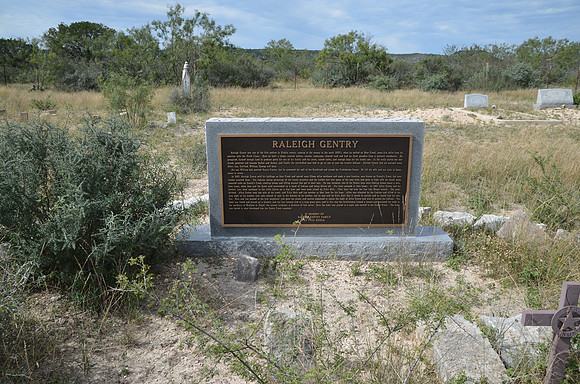
Gentry, Raleigh
Junction
Kimble County, Texas
Gentry Creek Cemetery
30 31.970' N 99 41.455' W
Text: Raleigh Gentry was one of the first settlers in Kimble county, coming to the county in the early 1850’s, when he settled on Bear Creek, some five miles from its junction with the North Llano. Here he built a home, erected stables, corrals, outhouses, cleared land and had an ideal paradise from a material standpoint. He farmed enough land to produce grain for use of his family and his stock, raised cattle and enough hogs for his family use. In the early sixties the war clouds gathered and became darker and darker, and finally the ablebodied men had to go to war or join the frontier defense. Raleigh Gentry had six stalwart sons; Allen, Lee, Guliford, William George and Jack. His son William had married Nancy Frazier, but he answered the call of the Southland and joined the Confederate forces. He left his wife and son John at home, never to return. In 1862, Raleigh Gentry sold his holdings on Bear Creek and moved some fifteen miles northeast and made a new location, now known as Gentry’s Creek, but here trouble awaited them. The Indians taking advantage of the lonely situation and the further fact that many of the men folks had gone to fight with the South made repeated raids on Gentry’s Creek, stealing horses and killing anyone that got in their way. On one occasion, two of the Gentry boys were hunting horses about a mile from home, when they saw the horse herd surrounded by a band of Indians and being driven off. The boys escaped to their home. In 1868 Allen Gentry and his brother, Lee, went northeast to the Little Saline on a hog hunt and were joined by Felix Hale. Their hunt led over the line into Mason County. The party divided. Allen Gentry took one side of the creek, and Felix Hale and Lee another in their hunt for the hogs. Allen was attacked by the Indians and killed in the very sight of his brother, Lee, who wanted to rush to the defense of his brother, but he was told by Felix Hale that it would be suicide and he would lose his own life. Hale and Lee dashed to the first neighbors’ and gave the alarm, and parties organized to rescue the body of Allen Gentry and also to pursue the Indians. The body was found and placed on a blanket, and the four corners tied to a long green pole, and in this way the frontiersman formed a hearse and conveyed the body to the residence of Matthew A. Doyal, the nearest neighbor, a distance of four miles. Here the body was placed in a hack and carried to the Gentry Creek. The body was buried in what developed into the Gentry Creek cemetery.