Laughlin Army Air Field
Del Rio
Val Verde County, Texas
29 22.071' N 100 47.929' W
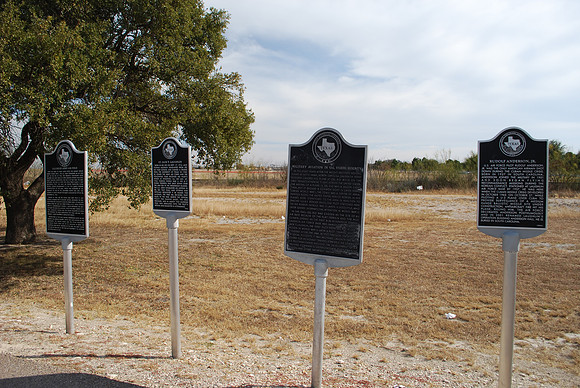
Text: With the need to train more pilots for military service during World War II, the U.S. Army established an air field east of Del Rio in 1942. The region's year-round good weather and vast areas of open ground offered near ideal flight training conditions. On July 2 of that year, the Army activated the field as what the local press called a "jaw-shattering title": The Army Air Forces Transition Flying School, Medium Bombardment. Lt. Col. E.W. Suarez oversaw construction of the base, which was accessible by U.S. Highway 90 and by the Southern Pacific rail line. Col. George W. Mundy became the base's commanding officer on December 26, 1942. Earlier in 1942, Del Rio native and Army pilot Lt. Jack Thomas Laughlin died in military action, becoming the first pilot from the community killed in World War II. He was shot down over the Java Sea while flying a B-17. Local citizens and U.S. Congressman Charles L. South petitioned the Army to name the base for Laughlin, which the Army agreed to in 1943. Laughlin's widow and the young daughter he never met attended the field's dedication that year, and Maj. Gen. Gerald C. Brant delivered a dedicatory speech. Instructors at the field trained experienced pilots on the Martin B-26 medium bomber, which was also known as the Marauder, the Widow Maker and the Flying Prostitute. Laughlin pilots went on to fly missions in both the European and Pacific theaters of the war. The Army closed the base at the end of the war but reopened it as Laughlin Air Force Base in 1952.