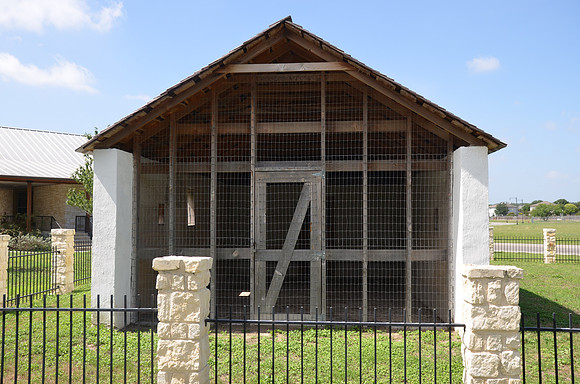
Harrison and McCulloch Stage Stop
Selma
Bexar County, Texas
29 34.953' N 98 18.328' W
Text: The Harrison and McCulloch Stage Line began running stagecoaches from the Texas coast to central Texas as early as 1848. The line was a partnership between brothers-in-law, John S. Harrison (1818-1864) and William McCulloch (1819-c. 1854), after dissolving their partnership with Dr. Caleb S. Brown of Gonzales (Harrison and Brown Stage Line) in 1850. Their stage line was part of a network of competing stage lines and “Star Routes” that contracted with the United States Post Office delivering travelers and mail throughout central Texas. Star Routes, 6285, 6154, and 6155 ran from Indianola, Port Lavaca and Galveston to New Braunfels and Austin and back. John S. Harrison also owned the Victoria Hotel in Victoria where he housed his stage passengers overnight on their way inland. In 1852, Harrison moved to Selma, making it his home. His house was listed on the National Register of Historic Places in 2006 and declared a State Archeological Landmark in 2009. Harrison was the first postmaster of Selma and held that position for two years. The Selma Stage Stop, as it is known today, was one of the stops on Harrison amp; McCulloch’s Star Route 6285 that ran from Austin to San Antonio. In 1852, the route took 18 hours to complete, leaving Austin at 3 AM traveling the Old Post Road and sections of the El Camino Real de los Tejas through open prairie to Manchac Spring, San Marcos, Bonito, New Braunfels and Selma, arriving in San Antonio at 9 PM that night. The Selma Stage Stop is a prime example of “Limecrete Construction,” a process using wooden forms and “Slip”, a mixture made from sand and pebbles found in the nearby Rio Cibolo. Shards of wood and corncobs were forced into the drying slip for added strength.