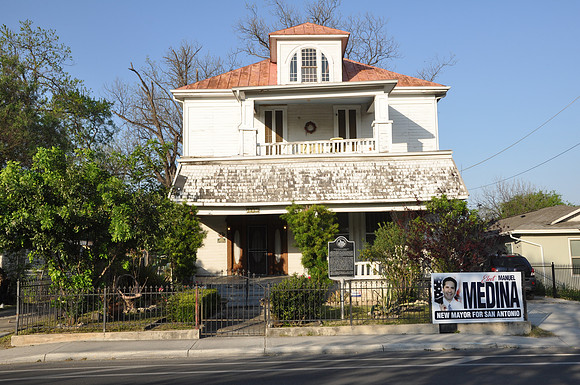
Venustiano Carranza in San Antonio
San Antonio
Bexar County, Texas
29 26.173' N 98 30.092' W
Directions: Start at the intersection of Marshall Street and Flores Street. Go 1/2 block north on Flores Street. The house is on the right (east) side of the street.
Text: Venustiano Carranza (1859-1920) was one of the early leaders of the Mexican Revolution and ultimately became president of his country. In 1898, during the presidency of Porfirio Diaz, Carranza represented the State of Coahuila as a Federal Senator. He became disillusioned with Diazrsquo; oppressive rule, and in 1910 endorsed Francisco I. Madero, whose Plan De San Luis Potosi advocated insurrection to change the government in power. In 1910, Madero fled to San Antonio, Texas, which became a haven for political exiles and displaced persons following the outbreak of the Mexican Revolution. Expatriates and insurgents left Mexico to escape persecution for their opposition to the Diaz regime. Many exiles moved between the private homes of friends and relatives in San Antonio to elude law enforcement agents and spies. During the upheaval in Mexico, Venustiano Carranza intermittently visited San Antonio and stayed here with his niece, Celia Carranza Cepeda de Trevino; she and her husband, Angel Trevino Sambrano, built a house in 1914 on land purchased from Commodore Cornelius Collins. During these sojourns, Carranza clandestinely met with partisans to discuss the course of the revolution and their plans for the future. Among the individuals who assembled here with Carranza was Leonides Gonzalez, general manager of La Prensa, an influential Spanish-language newspaper published in San Antonio. The house also facilitated cultural and social events for Mexicans exiled in the city. During Maderorsquo;s presidency (1911-1913), Carranza served as Governor of Coahuila. In 1917, he became President of Mexico and introduced constitutional reform. Venustiano Carranza was assassinated in Tlaxcalatongo, Puebla, on May 21, 1920.