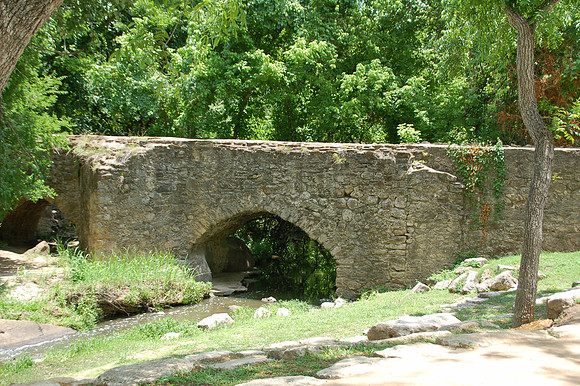
Mission San Francisco de la Espada Dam, Ditch and Aqueduct
San Antonio
Bexar County, Texas
29 19.955' N 98 27.716' W
Text: Water was vital to the permanency of San Francisco de la Espada Mission, therefore Franciscan missionaries built a dam, irrigation ditch, and aqueduct. The 270 foot dam rose eight feet above a rock ledge crossing the San Antonio River, the lime salts of which gradually cemented gravel, rocks, and layers of brush which formed the dam, regarded as an engineering feat as it curved "the wrong way". Water transported by Espada ditch crossed Piedras Creek via this aqueduct on which construction continued from 1740 to 1745. According to tradition, goat's milk served as a cementing agent in the mortar used in Espada Aqueduct, the only such structure in the United States. Relative prosperity followed for a generation as this alluvial valley produced crops of maize, beans, melons, calabashes, sweet potatoes, and cotton, but deterioration had set in a Espanda before the secularization of the mission in 1794, when only fifteen sick or aged Indians remained in the mission. Even so, dam, ditch, and aqueduct survived nearly a century of Indian attacks, ravaging floods, and conroversy, both secular and clerical. The ditch had fallen into disuse for some fifteen years when, in 1895, the newly forme dEspada Ditch Company repaired the dam, and enlarged the ditch while changing its course. When diaster again threatened to overtake this singular Spanish-American colonial irrigation project, in 1941 the San Antonio Conservation Society purchased this property to insure its preservation. Further assurance came in 1965, when the United States Department of Interior designated Espada Aqueduct as a Registered National Historic Landmark.