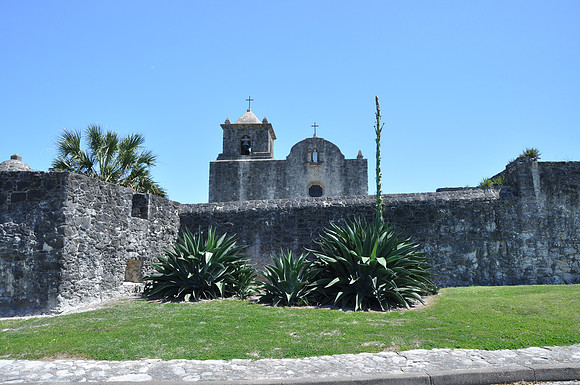
Presidio de Nuestra Senora de Loreto de la Bahia
Goliadbr/Goliad County, Texasbr/28 38.899' N 97 22.964' Wbr/ br/Text: (Fort of Our Lady of Loreto of the Bay) One of the most historic Spanish forts in Texas. Popularly called Presidio la Bahia, it was founded on Espiritu Santo (present Lavaca) Bay in 1722. Twice moved, it was re-established here in 1749 to protect Espiritu Santo Mission (1/4 mi. NW). In the chapel is the statue of Our Lady of Loreto placed here in 1749. The turbulent history of this fort has often rung with the sound of revolution. Between 1812 and 1820 several irregular quot;filibusteringquot; forces, including the Gutierrez-Magee Expedition and others led by James Long and Henry Perry, occupied or assailed the fort for various idealistic and profiteering motives. Here, too, 92 Texas citizens and soldiers drew up and signed Texas' first formal Declaration of Independence on December 20, 1835. In the ensuing War for Texas Independence, Col. James Fannin and 341 prisoners of war were held and, on Palm Sunday, 1836, were massacred in and around the fort by their Mexican captors. When the fort was authentically restored, 1963-67, by the Kathryn O'Connor Foundation, nine quot;levels of occupancyquot; were uncovered. Church services are now held in the chapel. The presidio has been named a registered National Historic Landmark.