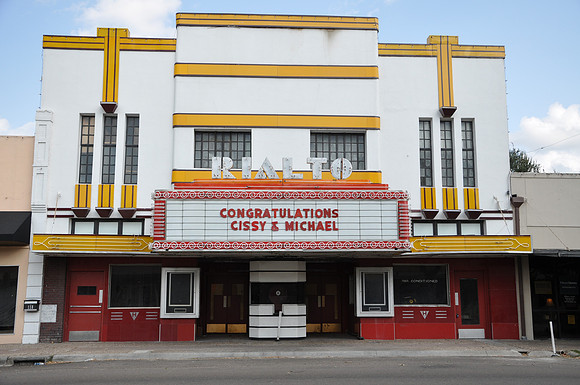
Rialto Theater
Beevillebr/Bee County, TXbr/28 24.132' N 97 44.952' Wbr/Directions: Start at the intersection of Washington Street and Corpus Christi Street. Go 100 feet north on Washington Street. The theater is on the right (east) side of the street.br/ br/Text: This distinctive building served as the flagship of a chain of 22 theaters in south Texas. In March 1922, brothers Henry and Sydney Hall announced plans to build a $25,000 two-story brick motion picture theater in Beeville. They bought this site, and Homer Boots was foreman during the construction, which took five months. The theater design included a stage large enough to host vaudeville performances and other attractions. W.C. Stephenson, who also designed the 1912 Bee County Courthouse, was the architect. The Rialto Theater opened on Saturday, August 19, 1922. The first film shown was The Three Musketeers starring Douglas Fairbanks; admission was twenty-five cents for adults and ten cents for children. On opening night, the management hired an orchestra to accompany the silent movie, since the $10,000 pipe organ had not yet arrived. More than 1,300 tickets were sold the first night for two showings. Here in December 1924, the Halls also started and early area radio station, KFRB, with a transmitter on the roof. Air conditioning was also a noted attraction, and the theater installed a sound system for quot;talkiesquot; in October 1929. In 1935, a fire that started in the basement gutted the building's interior. The Hall brothers hired atmospheric theater designer John Eberson to redesign the structure, and his exuberant Art Deco interior and Art Moderne exterior featured bold colors and geometric patterns in materials, finishes and fabrics. During World War II, movie stars came here to promote war bond drives. The theater survived flooding damage caused by Hurricane Beulah in 1967 but eventually closed in 1986. The Hall Rialto Preservation Association formed several years later to restore and reuse the historic theater.