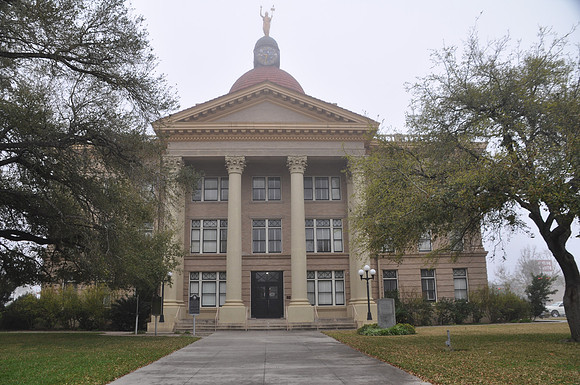
Bee County Courthouse
Beevillebr/Bee County, Texasbr/28 24.105' N 97 44.909' Wbr/Directions: Start at the intersection of Washington Street and Corpus Street. The courthouse is on the southeast corner of the intersection.br/ br/Text: Bee County was created in 1857 from parts of five neighboring counties. The first county seat was located seven miles east of this site, and the first commissioners court was held on the banks of Medio Creek in February 1858. The city's earliest courthouse consisted of a box frame structure. In 1912, local architect W. C. Stephenson designed this, the county's fourth courthouse. A native of Buffalo, New York, Stephenson aided in the design of the death mask of President William McKinley. He was the architect of several Beeville buildings, including the Rialto Theater, two churches and several houses, and later designed the Classical Revival McMullen County courthouse. W. C. Whitney, builder of three other Texas courthouses, contracted to build the Bee County courthouse for $72,050. Whitney died during construction and W. C. Stephenson's partner, Fritz Heldenfels, completed the project. Stephenson drew upon the strong contemporary influence of the French Beaux Arts School with a level of grandeur previously nonexistent in Bee County. Some original Beaux Arts features such as the cast stone balustrade originally outlining the roof were later removed, and the 1943 addition partially obscured the symmetrical plan and facade of the edifice. The Bee County courthouse is a fine example of the Classical Revival style. Of particular significance are the grand portico and projecting pediment entry with Corinthian columns and dentils along the roofline. The Chicago-style windows, comprised of one glass pane flanked by two narrower ones, with transoms above, are noteworthy. Also unusual is Stephenson's lady of justice; unlike most such symbols, she is not depicted as blind.