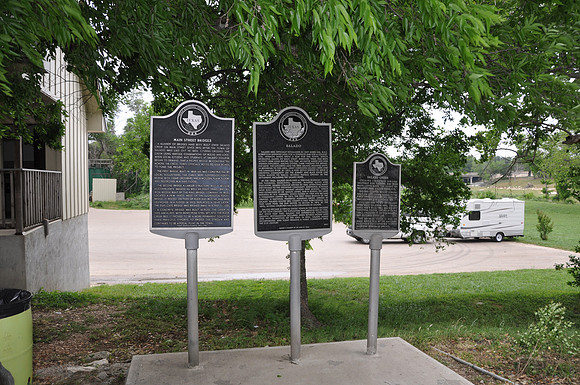
Salado
Salado br/Bell County, Texas br/30 56.619' N 97 32.227' W br/br/Text: Salado was officially established in 1859 when Col. E.S.C. Robertson donated land for a townsite and for a college. Col. Hermon Aiken drew a plat for the town, which developed along its main street. However, there had been activity her long before this time, as native Americans and Spanish explorers, among others, came through the spring-fed land. The explorers used the term Salado, meaning salty, in referring to this area, likely confusing Salado Creek and the Lampasas River. By 1852, a post office opened to serve a growing community on the Burney and Blair Stage Line from Austin to Waco. Several hotels opened in the settlement, including the Salado Hotel. By the 1860’s, Salado developed a thriving economy based on farming, ranching, milling mineral baths and education. Salado College opened in 1860, attracting many individuals to the growing community. Additional schools were built, including Thomas Arnold High School, which was established by Dr. Samuel Jones, and a school on land donated by W.K. Hamblen, which closed in 1969 and became a community center. In 1873, the first Texas branch of Grange, a national fraternal agrarian order, opened in Salado. Salado hosted Bell County’s first agricultural fair that same year; the fair moved to Belton in 1876. By the 1890’s, several churches had also organized in Salado. Salado became a virtual ghost town in the early decades of the 20th century; the population was around in 1950, but since that time, Salado had experienced continued growth. Revitalization occurred when retirees moved here and with promotion of the arts. In 2000, Salado again incorporated, and today remains a viable community into the 21st Century.