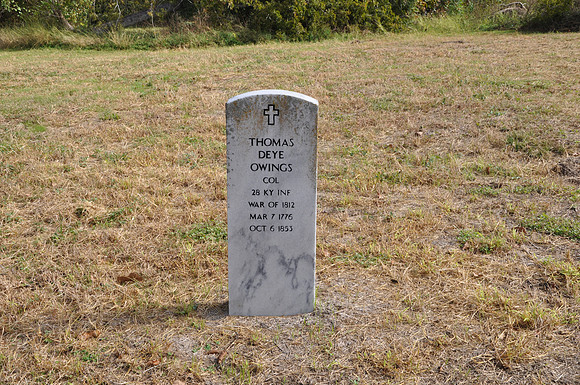
Thomas Deye Owings
Brenham
Washington County, Texas
30 11.032' N 96 24.102' W
Directions: Start at the intersection of Duprie Road and Old Masonic Cemetery Road. Go 100 yards north on Old Masonic Cemetery Road. The cemetery is on the right (east) side of the road.
Text: Thomas Deye Owings was born to John Cockey and Colegate Dye Owings on March 7, 1776 at Cockeysville, a suburb of Baltimore, Maryland. The family had met with success as colonial tobacco planters and as partners in the Bourbon Iron Furnace in Kentucky. In 1795, Thomas left his wife and young son in Maryland to go to Kentucky with his brother-in-law, Benedict Van Pradelles, and oversee the furnace operations and other landholdings. Circa 1800, after his first wife's death, Thomas wed Mary Nicholas, daughter of Kentucky governor George Nicholas. By 1810, Thomas was sole owner of the Bourbon Iron Works and involved in other businesses. To ship his products, he built the "Iron Road" from Owingsville, the Bath County seat he founded, to Lexington. Commissioned a colonel in the War of 1812, he led the 28th U.S. Infantry Regiment. He also supplied cannonballs and grapeshot for U.S. troops at the Battle of New Orleans. His former home in Owingsville is now a Kentucky landmark. In support of the Texas Revolution, Owings financed several companies of soldiers. Of the men he sent to Texas in early 1836, approximately 80 of them, including his own son Robert, were massacred at Goliad in March of that year. Owings arrived with 1,500 more men the day after Texas won the Battle of San Jacinto. After the revolution, Owings settled in the Brenham area. He died in October 1853 and was buried beside one of his sons at the Old Masonic Cemetery. His daughter Eliza was later buried here as well. Although he never served as a solder in the revolution, Owings is remembered as a Texas patriot for his support and family sacrifice.