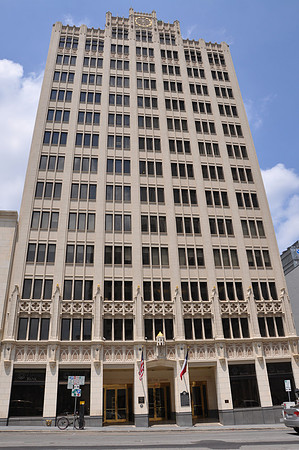
Norwood Tower
Austin
Travis County, Texas
30 16.139' N 97 44.604' W
Text: This building was once the tallest structure in Austin's downtown area other than the State Capitol. Dwarfed by other structures by the late 20th century, the Norwood Tower remains unique in its design and elaborate detailing. In 1925, Ollie O. Norwood (1887-1961) bought this site and hired the firm of Giesecke and Harris to design an office building. Bertram E. Giesecke (1892-1950) was the son of F.E. Giesecke, an architect, engineer and educator known for his experiments with reinforcing concrete. Bertram met August Watkins "Watt" Harris (1893-1968) in architecture school, and the men designed many buildings throughout Texas. The Gothic Revival tower, built of pre-cast concrete, features elaborate detailing, including a rose window, tracery, finials, gargoyles and a band of quatrefoils. Norwood Tower opened in 1929. Early tenants included Renfro Drugstore and numerous medical professionals, as well as long-standing area companies, such as Gracy Title Co., Elgin-Butler Brick and Brown amp; Root. Following two terms as Texas governor, Dan Moody operated his law firm in the building. The top two floors of the 16-story edifice provided space for residential living. The private office of longtime maintenance engineer Clarence O. Williams provided downtown restroom access to many African Americans during Austin's years of segregation. Throughout the building's history, various owners have maintained the landmark, renovated in the 1980s. The LBJ Holding Company purchased the property in 1997, and the architectural gem continues as an important link to Austin's early business history.