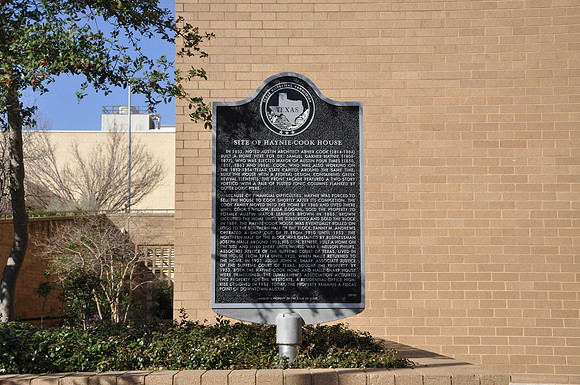
Site of Haynie-Cook House
Austin
Travis County, Texas
30 16.430' N 97 44.559' W
In 1852, noted Austin architect Abner Cook (1814-1884) built a home here for Dr. Samuel Garner Haynie (1806-1877), who was elected mayor of Austin four times (1850, 1851, 1863 and 1864 ). Cook, who was also working the 1852-1854 Texas State Capitol, around the same time, built the house with a federal design, containing Greek revival elements. The front façade featured a two story portico with a pair of fluted ionic columns flanked by outer doric piers. Because of financial difficulties, Haynie was forced to sell the house to Cook shortly after its completion. The Cook family moved into the home by 1860 and lived there until Cook’s widow, Eliza (Logan) sold the property to former Austin Mayor Leander Brown in 1885. Brown occupied the home until he subdivided and sold the block in 1889. The Haynie-Cook home was eventually rolled on logs to the southern half of the block. Fanny M. Andrews operated a shop out of it from 1910 until 1953. The northern half of the block was obtained by businessman Joseph Nalle around 1903. His son, Ernest, built a home on the site and lived there until World War I. Nelson Philips, associate justice of the Supreme Court of Texas, lived in the house from 1914 until 1920. When Nalle returned to the home in 1953, both the Haynie-Cook and Nalle-Sharp house were demolished. The Lumberman’s Association acquired this property for the Westgate, a residential office high rise designesd in 1962. Today, the property remains a focal of downtown Austin.