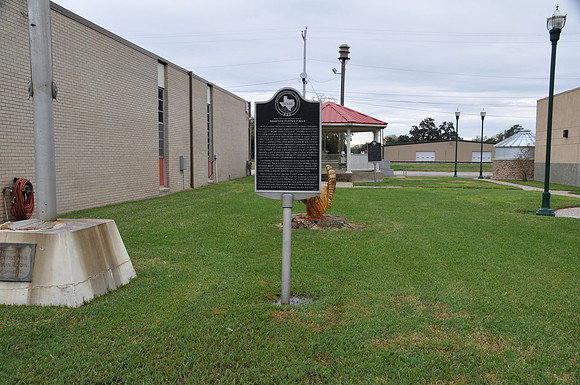
World War II Air Training School Brayton Flying Field
Cuero
DeWitt County, Texas
29 05.373' N 97 17.370' W
Directions: Start at the intersection of Stockdale Avenue and Main Street. Go 1/2 block west on Main Street. The marker is on the left (south) side of the street.
Text: In 1939 when the Nazis threatened world conquest, the United States had immediate need for thousands of pilots -- more than could be trained at military fields alone. Aid was enlisted from civilian flying schools. One field was established in Cuero under direction of Clyde E. Brayton, veteran pilot whose first licenses (1926-1931) were signed by air pioneer Orville Wright. Cuero provided land; Brayton put in facilities and enrolled the first class in March 1941. A staff of 550 civilians and 100 military men trained 6,611 students who flew 335,000 hours. The field received awards for safety and meritorious service. It ceased operating in August 1944. Favorable flying conditions made Texas the site of 17 civilian training schools, located at Ballinger, Bonham, Brady, Coleman, Corsicana, Cuero, Dallas, Fort Stockton, Fort Worth, Houston, Stamford, Sweetwater, Paris, Terrell, Uvalde, Vernon and Wichita Falls. Personnel in the United States Army Air Forces increased from 21,556 in 1939 to almost 2,500,000 in 1944; many received training at civilian schools. These installations also trained airmen for Brazil, China, England, France and Mexico. Their work was an important contribution toward Allied victory.