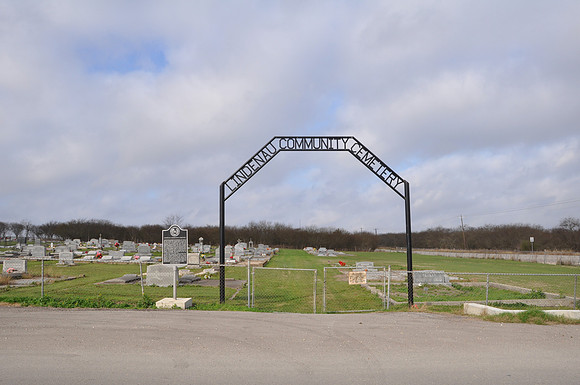
Lindenau Community Cemetery
Cuero
DeWitt County, Texas
29 07.104' N 97 23.257' W
Directions: Start at the intersection of CR-126 and CR-128. The cemetery is on the southwest corner of the intersection.
Text: The settlement of Lindenau was established in 1891 near the junction of Sandies Creek and the Guadalupe River. The large oak trees reminded early German pioneers Charles and Daniel Wild of the linden trees that grow in Germany, thus the name quot;Lindenau.quot; The brothers and Daniel's wife, Eloise Grohmann Wild, are buried here, along with their descendants. Located on the James Bell Survey in the German farming community of Lindenau, the Lindenau Community Cemetery was established as the St. John Lutheran Cemetery in 1905. In 1957, the officers of the church transferred the title of the cemetery land to the church's corporation, and in 1972, community members formed the Lindenau Community Cemetery Association, Inc. to care for the cemetery. At that time, the name was changed to Lindenau Community Cemetery, as people from other denominations were also interred in the cemetery. Two years later, the land was transferred to the cemetery association. The oldest burial in the cemetery is that of Heinrich Budde (1852-1903). Many veterans are buried here, along with members of fraternal organizations, victims of an early 1900s local flu epidemic and infants buried in a separate children's section, a common practice among Texas Germans. The spatial layout is very orderly, geometric and symmetrical, and some headstones in the cemetery are inscribed in the German language. This historic cemetery has hundreds of graves and is a significant burial ground for many descendants of the original German farmers who settled this region at the turn of the twentieth century.