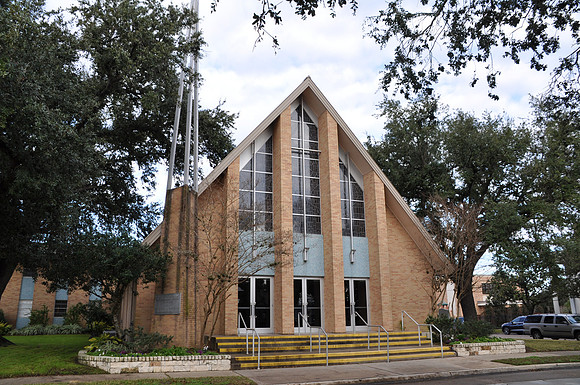
First United Methodist Church of Victoria
Victoriabr/Victoria County, Texasbr/28 48.155' N 97 00.345' Wbr/Directions: Start at the intersection of Bridge Street and Power Avenue. The church is on the southwest corner of the intersection.br/ br/Text: When Victoria was settled in 1824, Texas was part of Mexico and there were no Protestant churches. Itinerant Methodist ministers began to visit this area soon after Texas won independence in 1836. The Rev.Jesse Hord (1808-86), a missionary sent to this region by the Mississippi Conference of the Methodist Church, preached here in 1839. This congregation, formed in 1840 with the Rev. Joseph P. Sneed (1804-81) as pastor, was the first Protestant church in Victoria. Among its early pastors were the Rev. John Wesley DeVilbiss (1818-83), who helped conduct the first Protestant service in San Antonio in 1844, and the Rev. James E. Ferguson (1824-76), the father of Texas governor James E. Ferguson (1871-1944). Methodists worshiped first on South Street, then moved in 1852 to a small, frame building on Santa Rosa Street. In 1876 the steadily growing congregation occupied a frame structure on this site. Between 1896 and 1910, the church was known as Callender Chapel in memory of a prominent member, lawyer W.L. Callender. Damaged by a hurricane in 1886, the frame sanctuary was destroyed by a fire in 1910 and replaced by a masonry structure in 1911. The present facility was built in 1960. In the 1970s, the historic fellowship recorded a membership of over 1400.