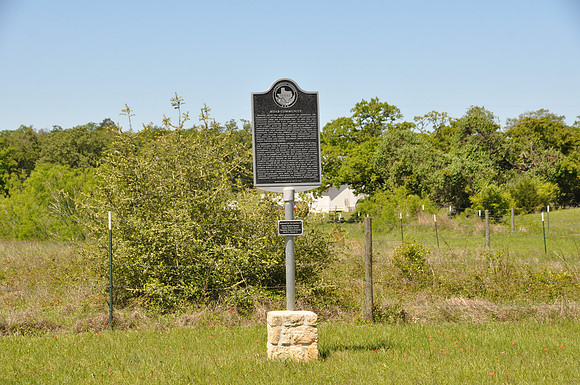
Moab Community
Lexingtonbr/Lee County, Texasbr/30 19.330' N 97 07.150' Wbr/Directions: Start at the intersection of CR-331 and CR-333. Go .6 miles north on CR-331. The marker is on the left (west) side of the road.br/ br/Text: Situated about ten miles southwest of Lexington, the community of Moab was a predominately African-American community. there are indications that the area was well populated before the civil war but became more so following emancipation. many quot;freedom coloniesquot; formed in Lee County after the Civil War and began new black landowner communities. Moab was mostly a community of farmers who were dependent upon income from crops. to supplement their income, families would go on quot;cotton picksquot; and follow cotton harvesting throughout Texas and parts of New Mexico. For food, families harvested peanuts, corn and other vegetables and raised hogs, cattle, chickens and turkeys. A community school opened around 1900 and, by the 1930s, the settlement had the school, two churches, a cemetery, post office and a number of scattered dwellings. According to a 1935 board of education survey, Moab's school employed two teachers with forty-eight students enrolled in grades one to ten. The school burned in the late 1930s but was rebuilt one year later. During the interim, the school was housed in the Methodist Church. Two churches existed in the Moab Community. Mount Zion Baptist Church was led by Rev. Person from the 1930s to the 1960s and the church had over 50 members at its peak. The Baptist Church burned in the 1960s and was not rebuilt. Mt. Nebo African Methodist Episcopal Church is the only church that remains in the community. Each year, special programs bring descendants back into the community. This once-thriving community represents a triumph in kinship and perseverance, and the beginnings of a people after slavery.