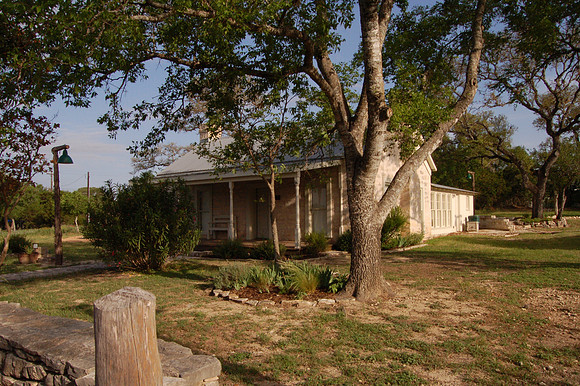
Winters-Wimberley House
Wimberley br/Hays County, Texas br/29 59.871' N 098 05.927' W br/br/Text: William Carvin Winters (1809-1864) and his wife Lavinia Winters (1805-1891) came to Texas from Tennessee in 1834, along with other members of his family. William and his brothers, James Washington and John Frelan, fought in the Battle of San Jacinto, where William was severely wounded. William became a noted woodcarver and furniture craftsman in Walker County and in Seguin. The Winters family eventually settled in Hays County. William and Lavinia arrived between 1853 and 1855 and he built a mill on Cypress Creek in 1856. The mill became the economic hub of the village, which took on the name Winters' Mill. William built a homestead on this site in 1857-1858. From here he could survey his sawmill and gristmill with its power source, Cypress Creek. One of the first stone houses in the area, the Winters house boasted 18-inch thick limestone walls. After William's death, his daughter Nancy and her husband John Cude took over the mill and the village became known as Cude's Mill. They sold the mill and family home to Pleasant and Amanda Wimberley in 1874. With their son Zachary, the Wimberleys expanded their business to include the production of flour and sorghum molasses as well as a cotton gin. The village name soon changed to Wimberleyville, later Wimberley. Zachary Wimberley's son-in-law, John Will Pyland, lived in the homestead and kept the mill in business until 1925. The evolution of the house, with its various alterations and additions, reflects the changing needs of the families who occupied it. A village landmark for generations, the Winters-Wimberley house remained with Wimberley family descendants until the 1990s.