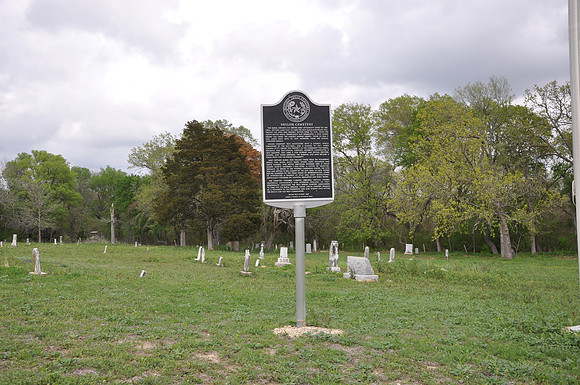
Shiloh Cemetery
Troy br/Bell County, Texas br/31 12.879' N 97 16.613' W br/br/Historical Marker: This burial ground has served area settlements since the mid-1800’s. Settlers came here to farm the rich blackland prairie soil. Though the area was sparsely settled prior to 1850, when the Austin-Belton-Waco stagecoach run established a stop along nearby Elm Creek, the earliest marked graves, those of Ema P. and Laban Gray, date to 1859. However, there are earlier, unmarked burials. Shiloh Cemetery was associated with a church, which organized by the mid-1850s, and a school in 1871, when Joanna Scott deeded this property to the community for burial, religious and educational purposes, residents constructed a new building. They used it for worship and revival services, school, and lodge meetings. The building and land became a focal point for the Shiloh community. Early settlers buried here include those from the pioneering Atkins, Cox, Meyer, Scott, Smith, Spohn, Teaff, Thompson and White Families. One noted individual interred here is Franz Joseph Moritz Maedgen (1830-1898), a native of Hanover, Germany. He served in the western campaigns during the Civil War and settled in Bell County by the late 1860s. In 1878, voters elected Maedgen to the Texas House of Representatives, where he introduced a number of bills and joint resolutions, particularly focusing on taxation, education and rural issues. The cemetery features curbing, obelisks, vertical stones, fraternal monuments, and interior fencing. In 1967, descendents organized Troy Shiloh Cemetery Association to care for the burial ground. Today, Shiloh remains as a testament to the pioneering men and women who settled the Shiloh and Old Troy communities.