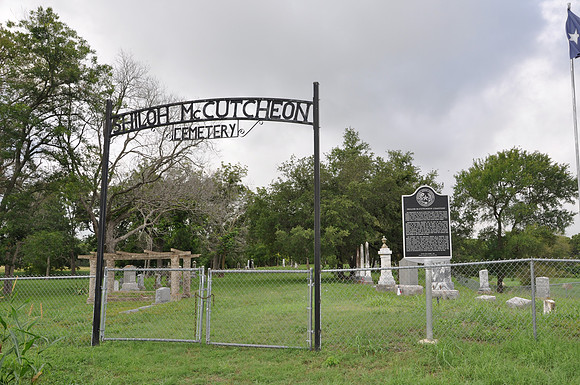
Shiloh-McCutcheon Cemetery
Hutto br/Williamson County, Texasbr/30 30.134' N 97 32.118' W br/br/Text: The community of Shiloh dates from 1848, when both Nelson Morey and Josiah Taylor established stores in this area. Shiloh spread along the banks of Brushy Creek near Wilbarger Crossing, which was later called Shiloh Crossing and Rogan Crossing. The community consisted of a school, a church, two stores and a few residents who lived along Brushy Creek.Shiloh-McCutcheon Cemetery sits on part of the original grant of 1852 acres issued to the heirs of William Gatlin because of his participation in the Texas Army during the revolution of 1835-1836. The first recorded burial is that of Josiah Kuykendall, who became ill with smallpox after a traveler spent the night at his home. His brother and neighbor, Mark Kuykendall, came to care for Josiah during his illness, but became ill himself. Both brothers died from the disease and were buried in the cemetery in 1853. The property was not officially deeded as a cemetery until February 1890, when William McCutcheon deeded land to three cemetery trustees, F.F. Farley, Green Randolf, and William Rogan. William McCutcheon, his wife Elizabeth Jane, and six of their thirteen children are buried here. Through the years, the burial ground has also been known as Shiloh, Old Shiloh, or McCutcheon Cemetery. Burials at the site include veterans of the Texas Revolution, Civil War, World War I and World War II. Due to the density of burials, interments are now restricted to the ashes of descendants of those already interred at the site.