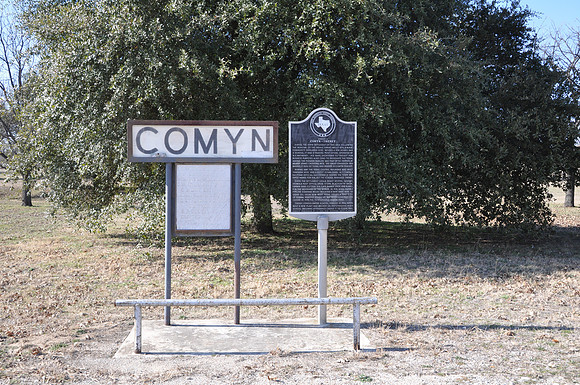
Community of Comyn-Theney
Comynbr/Comanche County, Texasbr/32 04.297' N 98 28.290' Wbr/Directions: Start at the intersection of CR-442 and FM-1946. The marker is on the west side of the intersection.br/ br/Text: During the rapid settlement of this area following the removal of the Indian threat, about 1875, a rural community developed here. Besides a few homes and a school, it had a trading post-store, operated by W. F. Matheney. His name, shortened to quot;Theneyquot; for business purposes also came to designate the town. Among the pioneer families was that of B. F. Barnes, at nearby Jones Crossing, 1876. His great-grandson Ben Barnes, Lt. Gov. of Texas, was reared in Comyn-Theney. During 1881 the Texas Central Railroad was built through here and a depot established. M. T. Comyn, a railroad official, succeeded in having the town and depot named for him, but the school remained Theney. Soon the settlement could boast several general stores, a post office, drug store, blacksmith shop, lumber yard, cotton gin, cafe, barber shop, and a hall for the Woodmen of the World. In 1918, when Humble Pipeline Company began building a tank farm here to store oil from new West Texas fields, a tent city of several hundred sprang up. But when construction ceased in 1919, the townspeople moved away. Theney Consolidated School, formed in 1924, soon built a new plant and became an outstanding high school. Declining attendance caused it to close, 1952.