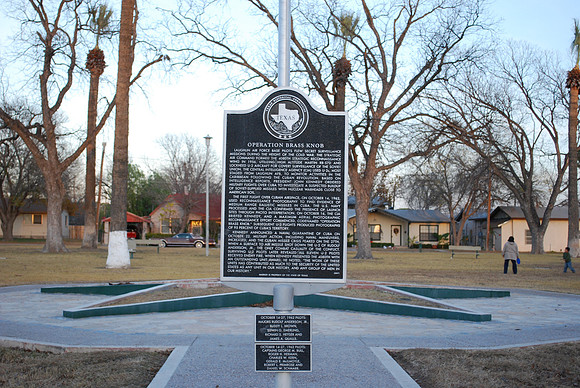
Operation Brass Knob
Del Rio
Val Verde County, Texas
29 22.127' N 100 54.208' W
Text: Laughlin Air Force Base pilots flew secret surveillance missions during the height of the Cold War. The Strategic Air Command formed the 4080th Strategic Reconnaissance Wing in 1956, utilizing high altitude Martin RB-57D and Lockheed U-2 aircraft for covert surveillance of the Soviet Union. The Central Intelligence Agency (CIA) used U-2s, most staged from Laughlin AFB, to monitor activities in the Caribbean following the Cuban Revolution. Based on intelligence reports, President John Kennedy ordered military flights over Cuba to investigate a suspected buildup of Soviet-supplied missiles with nuclear warheads close to American soil. The first flight over Cuban airspace, on October 14, 1962, used reconnaissance photography to find evidence of medium range ballistic missiles in Cuba. The U.S. Navy processed and the CIA confirmed the presence of launch sites through photo interpretation. On October 16, the CIA briefed Kennedy, and a maximum aerial photographic reconnaissance effort commenced, codenamed “Operation Brass Knob.” Subsequent U-2 flights produced photographs of 95 percent of Cuba’s territory. Kennedy announced a naval quarantine of Cuba on October 22. Military action, including naval maneuvers, increased, and the Cuban Missile Crisis peaked on the 27th, when a surface to air missile shot down the U-2 of Rudolf Anderson, Jr., the only combat casualty of the conflict. Surviving U-2 pilots later revealed all eleven U-2 pilots received enemy fire. When Kennedy presented the 4080th with an outstanding unit award, he noted, The work of these units has contributed as much to the security of the United States as any unit in our history, and any group of men in our history.