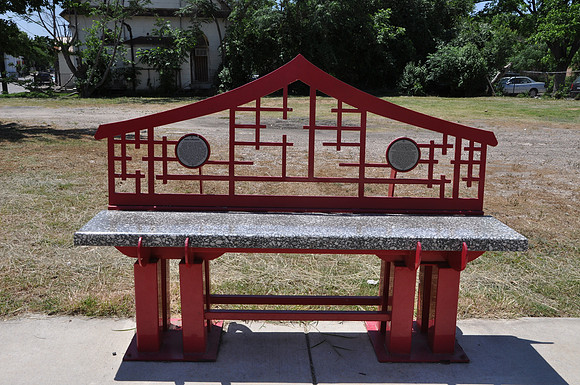
Public Art Bench - Eastside Asian Influence
San Antonio
Bexar County, Texas
29 25.186' N 98 28.227' W
Artist: James Wyatt Hendricks Asian Influence--In most of the U.S., these exotic “Oriental” elements were manifest in Japanese decorative effects built into bungalows. “Well into the twenties the prevailing style was a variation on the Swiss Chalet, with an Oriental feeling often added by slightly upturned eaves and sometimes a large amount of nonfunctional and very elaborate woodwork around the porch columns. In fact, some of the bungalow books actually label these eclectic facades “Japo-Swiss”.” By the 1930s, the term “bungalow” began to be interpreted broadly to indicate a lifestyle or a dwelling with “Japo-Swiss” characteristics. The Aesthetic Movement, and adjunct to the Arts and Crafts movement in England and the U.S., peaked in the 1870s-1990. Its adherents were concerned with integrating art and beauty into everyday living. Oriental style houses were built all over the United States, but the Oriental mode became more popular in California than anywhere else in the country. And so it is with bungalows with Oriental influence. Almost every city which grew in the first third of the 20th century has a few of them. Some may have been designed by local architects, but most were probably built from plans obtained or published by developers or purchased by individuals.